
Time and attendance for payroll and HR BPO
Outsourcing teams administer working time for many client entities at once, often across borders and under different collective agreements. XperienceHR gives each client one tenant for its countries, legal entities, pay groups and sites. BPO staff work inside that tenant under role-based access, approvals can cross borders, and payroll receives approved units per run. XperienceHR does not run payroll.
Workday, SAP and ADP integrations · Payroll integration via XP-Hub · 15 years powering global payroll
The BPO operating problem
A BPO service desk receives timesheets, absence requests and corrections from many client entities. Each entity has its own calendar, overtime rules and cut-off. When this work runs through spreadsheets and email, the service team re-keys data, chases approvals and answers audit queries without a single record. XperienceHR moves the record, the rules and the approvals into one controlled system per client.
For the BPO, time administration becomes a standard managed service per client. The same tenant model, roles and payroll output are reused for each new client, with less re-keying per entity.
Access model for service teams
| Role | Typical holder in a BPO engagement | Scope |
|---|---|---|
| Employee | Client employee | Own time, absence and corrections |
| Manager | Client line manager | Approval for direct reports, including reports in other legal entities |
| HR admin | BPO service team or client HR | Employee records, calendars and leave balances for assigned entities |
| Payroll admin | BPO payroll team | Period close, payroll export and delta review for assigned pay groups |
| System admin | BPO lead or XperienceHR support | Configuration, roles and effective-dated rule changes |
Roles are assigned per legal entity. A service agent can switch between the entities in scope inside the application, without a separate login per entity.
What the service team controls
Cross-border approvals
A manager in one country can approve staff employed by an entity in another. Role-based access and in-app legal-entity switching keep each approval inside the permitted scope.
Rules per country and agreement
Country rules, public holidays, leave and collective-agreement provisions are configured per country. Changes are effective-dated, history is preserved and earlier periods can be replayed with the rules that applied at the time.
Validation before period close
Validation rules act as hard stops that block approval or as warnings that managers see before approving. The service team closes a period only when open exceptions are resolved.
Units per run, corrections as deltas
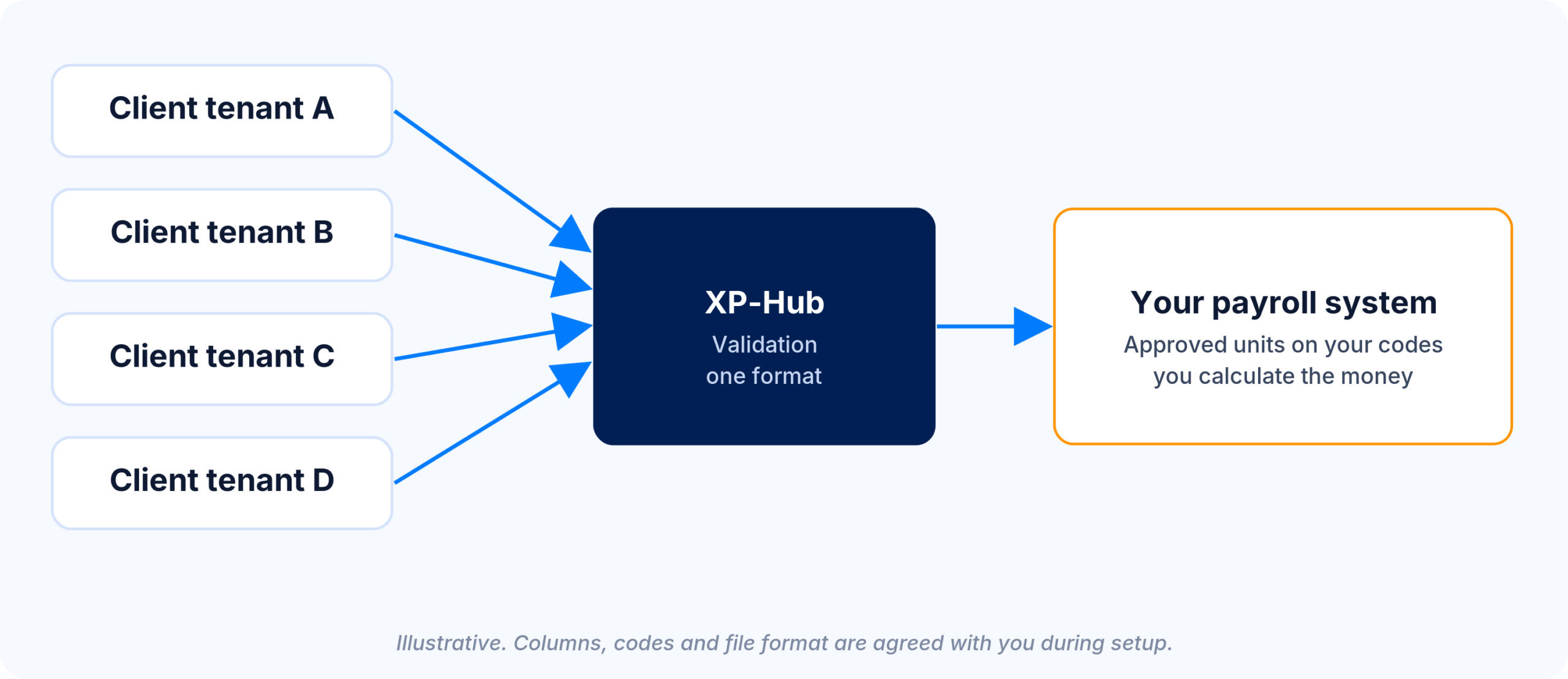
Approved hours, overtime, premiums, allowances and time off are prepared on the pay codes of the payroll engine in use. Delivered periods are frozen, and later changes travel as delta entries with an audit record.
Client onboarding in a BPO portfolio
1. Scope the entity set: countries, legal entities, pay groups, sites and the collective agreements in force.
2. Connect HR data: HR data can arrive daily as a full snapshot plus changes, with mismatches reported back to the service team.
3. Assign roles: service staff receive HR admin or payroll admin rights for the entities they administer.
4. Parallel run: one entity runs alongside the current process until the outputs reconcile, and further entities follow on the same template.
Integration across a client portfolio
XP-Hub connects XperienceHR to HR and payroll systems by REST API, batch file or middleware, with schema validation and monitoring. One integration layer serves multiple payroll endpoints, so a format defined for one client can be reused for the next.
Security evidence for client due diligence
XperienceHR provides SAML single sign-on, role-based access, TLS in transit, AES encryption at rest and a full audit trail. XperienceHR is ISO 27001 certified. Documentation for client security reviews and a data processing agreement (DPA) are available on request.
Frequently asked questions from BPO providers
Yes. Roles are assigned per legal entity, and authorised staff switch between entities inside the application.
Yes. Cross-border approvals are supported through role-based access and legal-entity switching.
No. XperienceHR delivers approved units on the pay codes of the payroll engine, and the payroll engine calculates the amounts.
Delivered periods are frozen. Later changes are delivered as delta entries with a full audit record.
HR data can arrive daily as a full snapshot plus changes, by file or API through XP-Hub, and incoming data is validated with mismatches reported back.
Partnership enquiries
Enquiries cover the client portfolio, the countries administered and the current time data flow. The response includes an access model mapped to the service team structure.
Contact: info@xperiencehr.com · +421 905 440 035 · USA +1 646 926 0897
Related: Partner programme · XP-Hub · Payroll engine · Security · Payroll providers